
Short Term Rental Insurance: A Practical Guide for Hosts
Your standard homeowners insurance policy won’t cover income from short-term rental guests. Most policies explicitly exclude business use, leaving you exposed to significant financial risk.
At Peninsula Insurance Services, we’ve seen hosts lose tens of thousands in uninsured claims because they didn’t realize their regular policy had gaps. Short-term rental insurance fills those gaps and protects both your property and your income stream.
Why Standard Homeowners Insurance Doesn’t Cover Rental Income
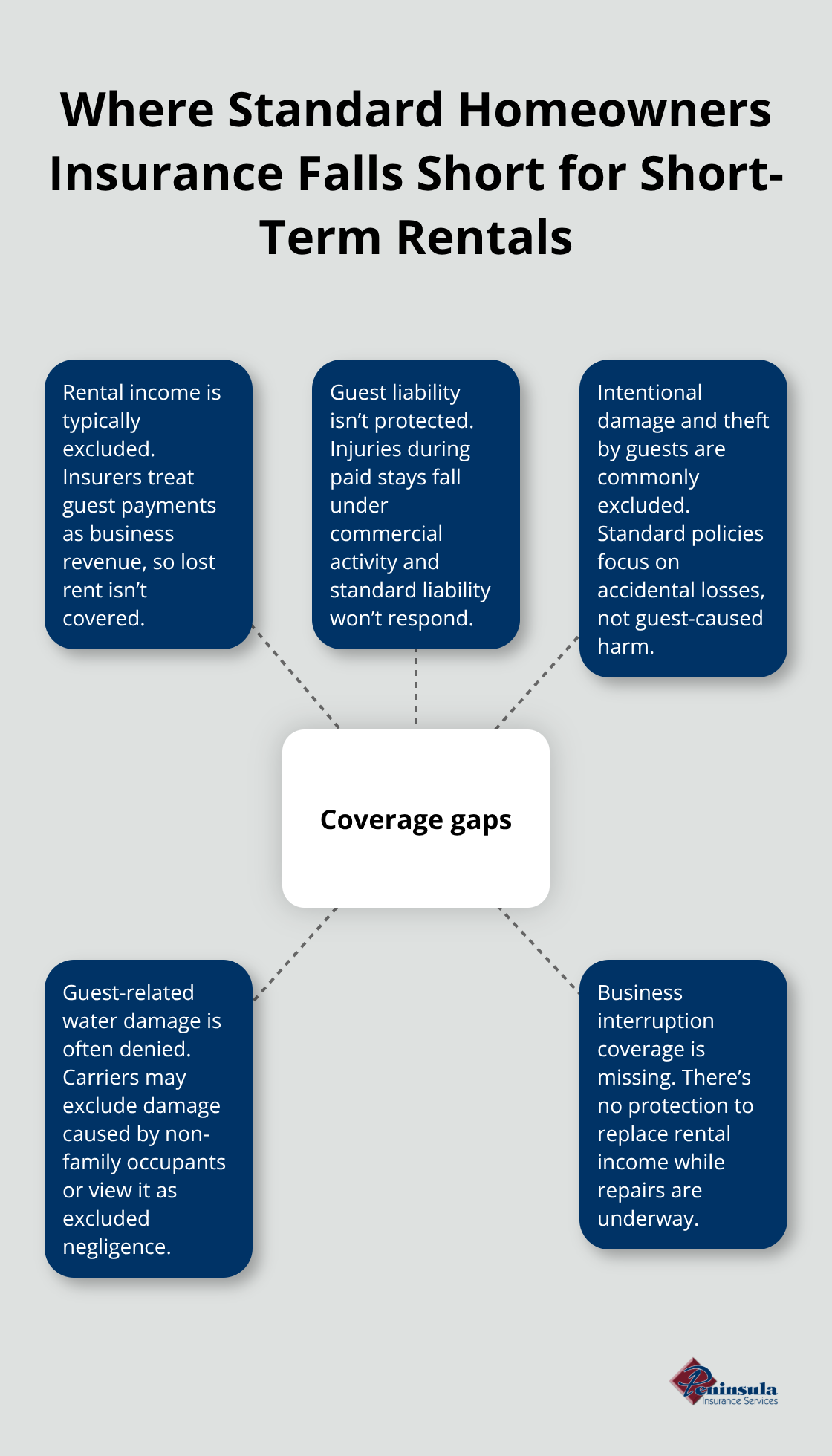
Standard homeowners policies treat short-term rental activity as commercial business use, which falls squarely outside their coverage scope. When you rent your home to guests for fewer than 62 days per year, your insurer views this as converting residential property into a commercial venture. Most policies include explicit exclusions for any rental income or guest-related claims. If a guest damages your kitchen or your property burns down while occupied by paying renters, your standard policy will likely deny the claim outright. The financial impact extends beyond property damage alone.
The Liability Gap That Exposes You Personally
If a guest sues you for injuries sustained on your property, your standard homeowners liability coverage won’t respond because the injury occurred during a commercial rental activity. A single personal liability lawsuit related to a guest can easily reach six figures in damages, leaving you personally liable for amounts far exceeding typical homeowners limits of $100,000 to $300,000. Your standard policy simply wasn’t designed to protect you in this scenario, and your insurer will reject the claim based on the commercial nature of the rental activity.
Water Damage and Guest-Caused Destruction
Water damage from guest-related incidents commonly costs between $20,000 and $50,000 to repair, depending on severity and how quickly you discover the problem. A burst pipe left unattended for days, a flooded bathroom from a guest’s negligence, or damage from an overflowing washing machine can devastate your property and your finances. Standard homeowners policies exclude intentional damage or damage caused by occupants who aren’t your family, meaning guest-caused water damage falls into a coverage void. Theft and vandalism from guests represent another significant exposure that standard policies won’t cover during rental periods.
The Income Loss You Can’t Recover
Hosts also lose rental income when properties sustain damage, yet standard homeowners insurance provides no business interruption protection. If your property becomes uninhabitable for three months due to a fire or flood, you forfeit that income with no insurance recovery. The gap between what your standard policy covers and what you actually need becomes painfully obvious when claims arise. This is precisely why dedicated short-term rental coverage exists-to address these specific exposures that standard homeowners policies systematically exclude.
Your Coverage Options Beyond Standard Homeowners Insurance
Platform Protections Fall Short of Real Insurance
Airbnb and Vrbo offer host protections that sound comprehensive until you examine the details. Airbnb’s Host Guarantee covers up to $3 million, but it only activates after your own insurance exhausts its limits, excludes certain damage types, and forces you through their dispute resolution process. This protection shields the platform, not you. If a guest causes $30,000 in water damage, Airbnb won’t pay until you file a claim with your own policy and face denial. Many hosts operate under the false assumption that platform coverage suffices, only to discover massive gaps when injuries occur on their property. Business interruption coverage during property damage doesn’t exist in platform programs, meaning you lose rental income while repairs happen with no recovery mechanism.
Standalone Short-Term Rental Policies Provide Comprehensive Protection
Dedicated short-term rental insurance policies eliminate the gaps that platform protections leave open. Standalone STR policies remove arbitrary day limits-you can rent 365 days per year if you choose-and provide comprehensive building and contents coverage, guest damage coverage that includes intentional damage and theft, and commercial liability limits starting at $1 million. These policies cost between $1,400 and $3,500 annually depending on property type, location, and occupancy rate. Liberty Mutual and USAA quote some hosts around $1,400 to $1,600 per year for solid coverage, while STR-specific carriers like Proper may charge more but offer enhanced guest-damage protections. The three essential coverages within standalone policies are commercial general liability, building and contents protection with full replacement value, and guest entrustment coverage that protects against theft and vandalism without excluding voluntary entrustment scenarios.
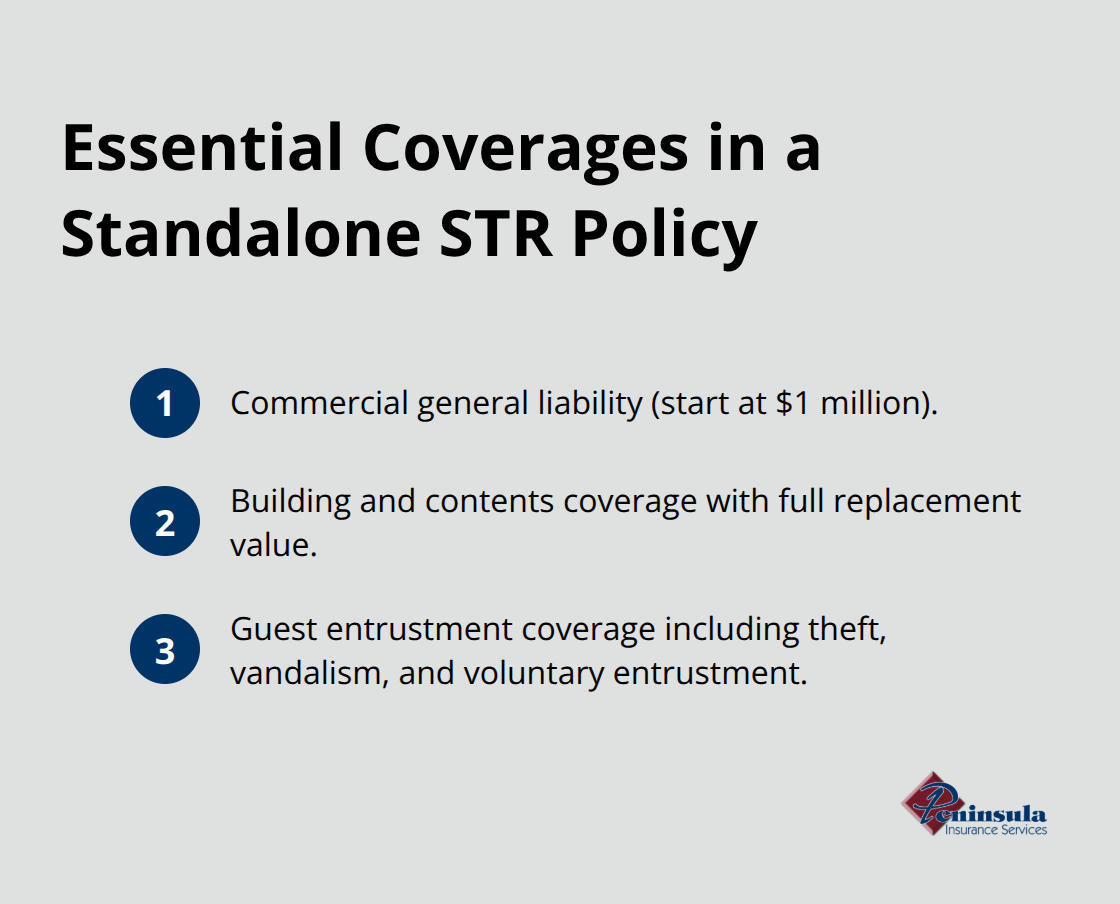
Loss of income coverage typically runs about three months, replacing your rental income while the property remains uninhabitable. If you own multiple rental units, bundled enterprise coverage streamlines management and reduces per-unit costs significantly compared to separate policies.
Landlord and Commercial Policies for Investment Properties
Landlord and commercial policies represent a middle ground for investors operating multiple properties or treating rentals as pure business ventures. These policies work regardless of ownership structure-personal name, LLC, or corporation-and suit investment properties where personal use is minimal or nonexistent. They often cost less than dedicated STR policies but provide narrower coverage, sometimes excluding intentional guest damage or capping loss of income at lower amounts. The key difference is that landlord policies assume commercial operation from the start, whereas STR policies are purpose-built for the unique risks of short-term guest stays.
Matching Coverage to Your Rental Activity
Your rental activity level and property structure determine which coverage type makes the most sense. Part-time hosts who rent fewer than 180 days annually might add an endorsement to their homeowners policy for $200 to $600 per year, extending property and liability coverage to paying guests. Full-time operators or investment property owners benefit more from standalone STR policies that remove day limits and provide broader protections. The choice between these options shapes your financial exposure and claims experience significantly. Understanding what each option covers-and what it doesn’t-prevents costly surprises when damage or liability claims arise.
Which Coverage Limits Actually Protect Your Investment
Calculate Your True Replacement Cost
Start with your property’s replacement cost, not its market value. A $400,000 home might cost $600,000 to fully rebuild after a fire, depending on local labor and material costs. Your policy limits must cover that reconstruction expense in full. Most standalone STR policies offer building coverage with full replacement value, meaning the insurer pays what it actually costs to rebuild, not what you paid for the property. This distinction separates adequate protection from financial exposure.
Set Guest Damage Limits That Match Your Furnishings
Guest damage coverage limits vary significantly across carriers. Some cap guest-caused losses at $10,000 while others provide $50,000 or more. If you furnish your rental with mid-range furniture and appliances, a $10,000 cap leaves you absorbing substantial costs after a guest trashes the space. Assess your property’s contents value and select a limit that covers replacement of your furnishings, fixtures, and equipment without forcing you to absorb major losses yourself.
Prioritize Liability Limits Above Standard Homeowners Coverage
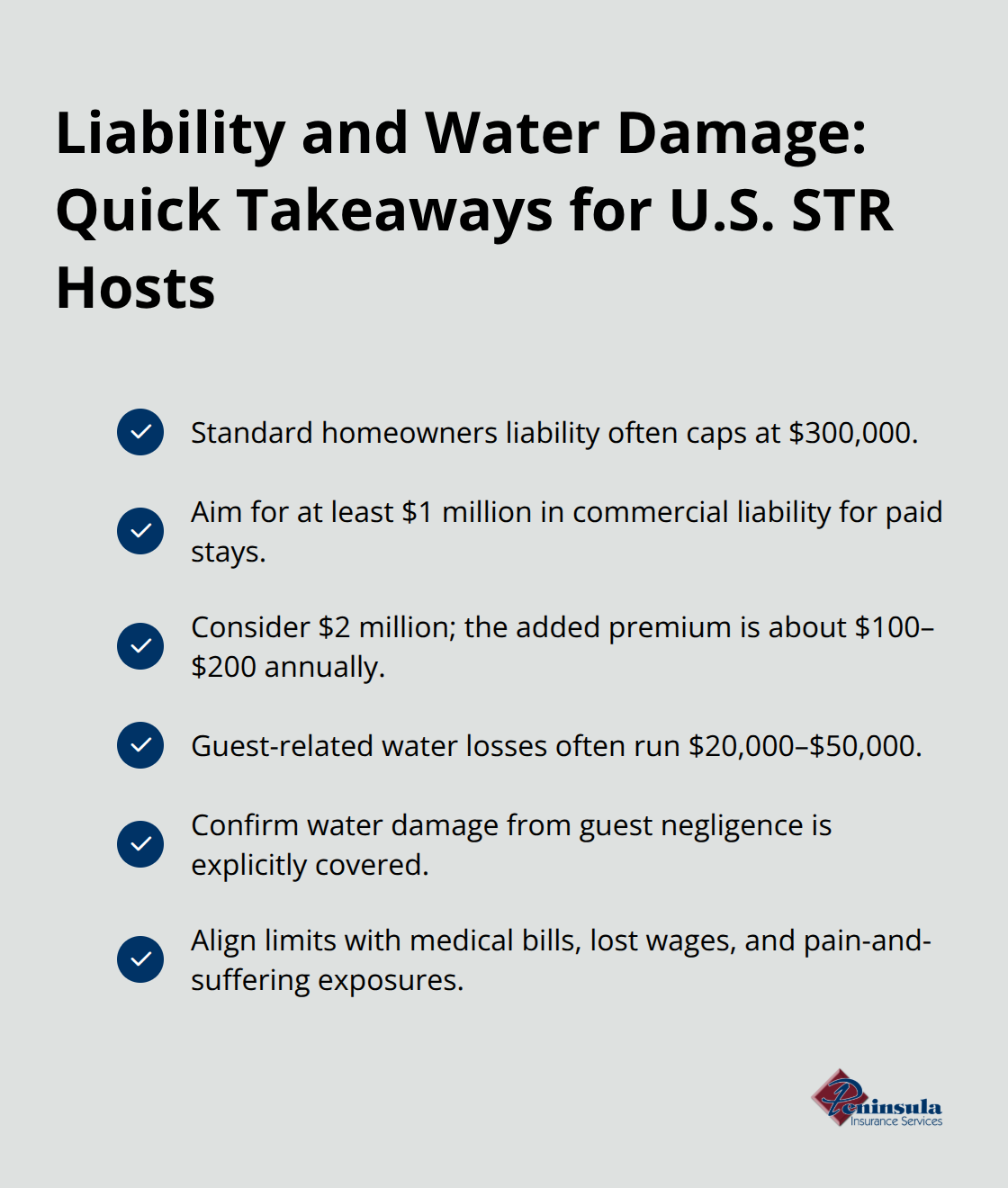
Liability limits matter equally to property coverage. A single guest injury claim can exceed $500,000 when medical bills, lost wages, and pain-and-suffering damages accumulate. Standard homeowners policies top out at $300,000; dedicated STR policies start at $1 million and go higher. The difference between a $1 million and $2 million liability limit costs roughly $100 to $200 annually but protects you from six-figure personal liability exposure. Water damage deserves special attention because guest-related water incidents run $20,000 to $50,000 on average. Verify that your policy covers water damage from guest negligence without excluding it as intentional damage.
Structure Your Deductible and Loss of Income Coverage
Loss of income coverage typically replaces three months of rental revenue while your property sits uninhabitable after a covered loss. Calculate your monthly rental income and confirm the policy limit covers at least that amount times three. A property generating $5,000 monthly needs $15,000 in business interruption protection at minimum.
Your deductible choice directly impacts your out-of-pocket costs when claims happen. Higher deductibles like $2,500 or $5,000 lower your annual premium but force you to cover those amounts before insurance pays anything. If water damage costs $35,000 and your deductible is $5,000, you pay that first $5,000 yourself. Lower deductibles of $500 to $1,000 raise your premium slightly but reduce financial shock when claims occur. For rental properties generating steady income, lower deductibles often make sense because the premium difference is minimal compared to the protection gained.
Verify Your Mortgage Lender’s Requirements
Your mortgage lender’s requirements typically appear in your loan documents under property insurance provisions. Most lenders require coverage equal to the loan balance, not the full replacement cost, which creates a gap you must cover yourself. Contact your lender directly and provide them with your STR policy details before purchasing coverage. Some lenders have specific carrier preferences or exclude certain coverage types, and discovering this after buying a policy wastes money and creates coverage headaches. A handful of lenders explicitly prohibit STR activity or require commercial policies rather than residential endorsements, so this conversation is essential before committing to any coverage option. If you own your property outright without a mortgage, you have complete flexibility to choose coverage based solely on your protection needs and risk tolerance.
Final Thoughts
Short-term rental insurance protects your property, your income, and your personal finances in ways standard homeowners policies simply cannot. The gaps are real, the costs of being uninsured are substantial, and the solution is straightforward: coverage designed specifically for rental hosts eliminates these exposures. Platform protections like Airbnb’s Host Guarantee leave you personally liable for amounts exceeding their limits, while standalone policies provide commercial liability starting at $1 million, guest damage coverage that includes theft and vandalism, and business interruption protection that replaces your income during repairs.
The annual cost of $1,400 to $3,500 for short term rental insurance is negligible compared to a single water damage claim running $20,000 to $50,000 or a liability lawsuit reaching six figures. Your mortgage lender’s requirements, your property’s replacement cost, and your occupancy rate all shape which coverage option makes sense for your situation. Getting quotes from carriers that understand short-term rental risks takes minutes and reveals the protection gaps in your current setup.
Contact Peninsula Insurance Services to compare coverage options tailored to your specific property, occupancy rate, and income needs. Our independent agency in Okemos, Michigan helps real estate investors and hosts craft protection that actually covers what matters. Secure appropriate coverage before your first guest arrives, and you’ll have the peace of mind that comes from knowing your investment is truly protected.
Disclaimer: The information provided in this blog is for general informational purposes only and does not constitute legal, financial, or insurance advice. Coverage options, terms, and availability may vary. Please consult with a licensed professional for advice specific to your situation. Artificial intelligence may have been used to generate text and images in some blog articles.
 Ensuring the safety of your vehicle extends beyond just maintaining its mechanical components; it also involves regularly inspecting your tires for signs of wear and potential hazards. While tire pressure is important, there are other crucial aspects of tire safety that deserve attention. Familiarize yourself with these five signs indicating that it may be time to replace your tires, and prioritize your safety on the road.
 For those of us who have a passion for collecting classic cars, it’s important to have an insurance policy that aligns with our specific use and ensures the appropriate value coverage for these valuable assets. Insuring a classic car is different from insuring your everyday vehicle. Classic car insurance policies are typically more affordable and are based on an agreed value. These policies can be tailored to suit your specific vehicle, restoration stage, or usage. Here are some examples of how you can customize your classic car insurance policy:
 Owning a swimming pool is a delightful luxury that requires diligent maintenance, but the joy it brings on a scorching summer day is truly priceless. If you have children, the pool quickly becomes their favorite gathering spot with friends. While owning a swimming pool can offer a fantastic experience, it also comes with a unique insurance liability risk.
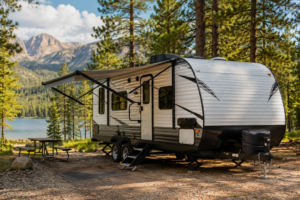 As summer approaches, camping enthusiasts eagerly anticipate venturing into the great outdoors and making the most of nature. If you own a camper or trailer, it’s essential to complete a quick tune-up to ensure your vehicle is ready for summer use. While some campers opt for professional servicing, it is entirely possible to perform the maintenance yourself. Here are six crucial areas to check when prepping your camper for summer adventures:
 Leaving your home for an extended period of time, whether for a vacation or as a snowbird seeking warmer climates, requires careful preparation to ensure the safety and security of your property. The last thing you want is to return to a home damaged by a burst pipe or burglarized. To protect your home and give yourself peace of mind while you’re away, follow this comprehensive checklist:
 “I was involved in an accident, and to make matters worse, the other party doesn’t have insurance.” It’s a frustrating and stressful situation that no one wants to experience. However, there are measures you can take to protect yourself from such incidents. One important aspect is having the right insurance coverage, specifically uninsured motorist coverage, which can provide you with the necessary financial support in these unfortunate circumstances.
 Experiencing a home disaster is a situation nobody wants to face, but unfortunately, it can happen unexpectedly. If such a disaster were to strike, would you be able to provide a detailed list of all the valuables in your home? If your answer is uncertain or no, it’s crucial to create a comprehensive home inventory list that includes all your valuable possessions.
 We often come across advertisements urging us to bundle our insurance policies together, promising savings and convenience. But what lies behind this recommendation, and is it truly a better option for your insurance needs? Let’s dive into the benefits of bundling and explore whether it’s the right choice for you.
 As summer approaches, many of you are eagerly preparing to take your boats out on the water or perhaps even considering purchasing a new one. When it comes to insuring your boat, it’s important to prioritize having the right coverage rather than simply opting for the least expensive policy. While boating season offers incredible fun and excitement, being on the water also comes with certain risks. As you shop for boat insurance, make sure your policy includes three specific coverages, which are sometimes optional but highly recommended:


